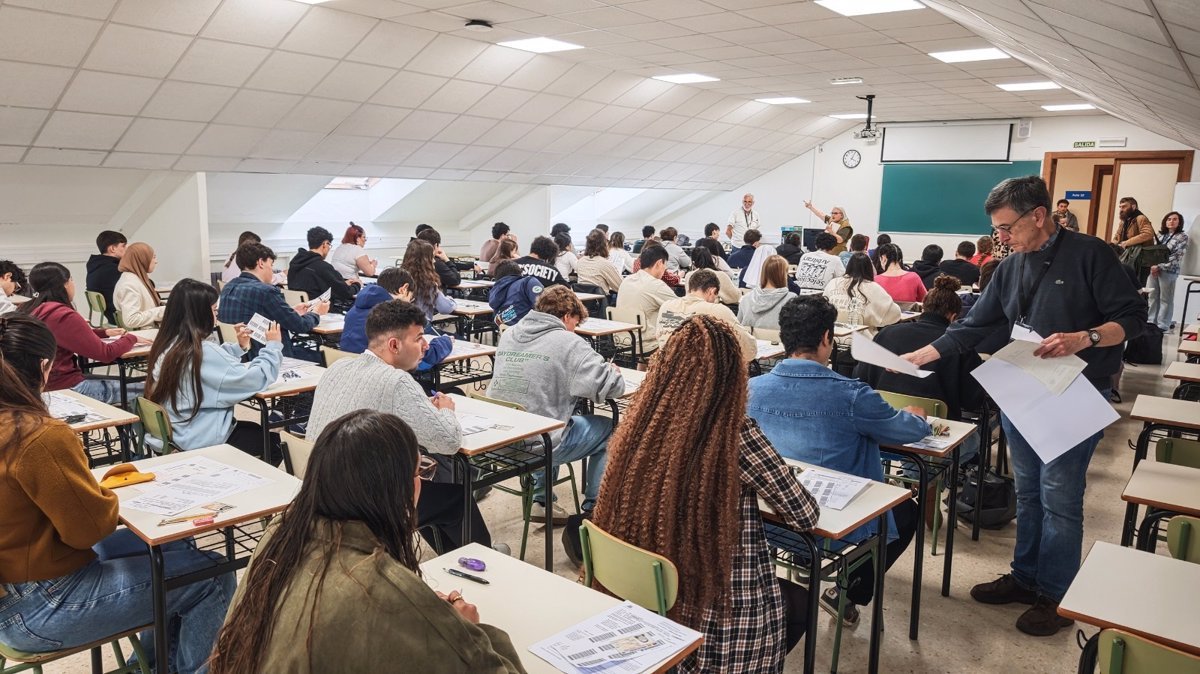
The vast majority of the 5,113 students registered in Asturias for the June session of the University Access Test (PAU) have begun their exams on Tuesday for the subjects of Spanish Language and Literature II and Foreign Language. The article Turismofobia, written by Juan Claudio de Ramón and published in The Objective, has been chosen for the Spanish Language and Literature exam.
In the same Language and Literature test, a fragment of the play ‘¡Ay, Carmela!’, by the Valencian playwright José Sanchís Sinisterra, has been included. The texts ‘Mass tourism’ and ‘Social connections’ are the options that have appeared in the Foreign Language exam, in English.
According to the University of Oviedo, the exams, which run until Thursday, are progressing smoothly in the 17 venues, mostly university locations, located in Oviedo, Gijón, Avilés, Mieres, Langreo, Ribadesella, Cangas del Narcea, Luarca, and Tapia de Casariego. This year, 25 more students have registered compared to last year, when 5,088 students took the test.
Alfonso López Muñiz, the Vice-Rector of Students and Employability, expressed his satisfaction that the exams have started without incidents at all venues. In the current context of the education strike, he emphasized that all Secondary School teachers who are collaborating with the PAU have fulfilled their responsibilities and reported to their positions.
López Muñiz also thanked the teachers for their behavior and professionalism in conducting a test that, as he mentioned, holds a "transcendental importance" for the future of the students.
This year, the PAU introduces a new optional structure where students, to achieve the highest grade, must respond to at least 80% of the content of the subjects, following the agreements of the CRUE and ministerial regulations.
The Vice-Rector noted that if this new model has any impact on the results, it will be consistent for everyone, as the PAU is a national test involving nearly 400,000 students who would be equally affected. He believes that the impact should not be very significant because students are responsible and well-prepared, and the new type of questions, more competency-based, suggests that the grades will remain similar to previous years.
ACCESS AND ADMISSION
Baccalaureate students must take exams in the four subjects that constitute the access phase, studied in the second year of Baccalaureate according to the chosen modality and itinerary. Each exercise in the access phase will be graded from 0 to 10 points.
The grade for this phase will be the arithmetic mean of the grades obtained in each subject, expressed on a scale of 0 to 10 points with three decimal places and rounded to the thousandth. This grade must be equal to or greater than 4 points to be averaged with the final baccalaureate grade.
The PAU grade, replacing the EBAU denomination this year, will be calculated based on 60% of the final Baccalaureate grade and 40% of the access phase grade. It will be considered that a student meets the access requirements when the result of this formula is equal to or greater than 5 points. The maximum grade in this phase is 10 points.
Students who wish to improve their grade to access their university studies must also participate in the admission phase. This phase will evaluate subjects from the second year of Baccalaureate. The subjects in this phase do not need to have been studied in Baccalaureate to be evaluated in the test, and students can take a maximum of three subjects. The final grade after both phases (access and admission) will reach a maximum of 14 points.