If the negotiations between the unions and Lydia Espina do not progress, they announced on Monday that they will start an indefinite strike
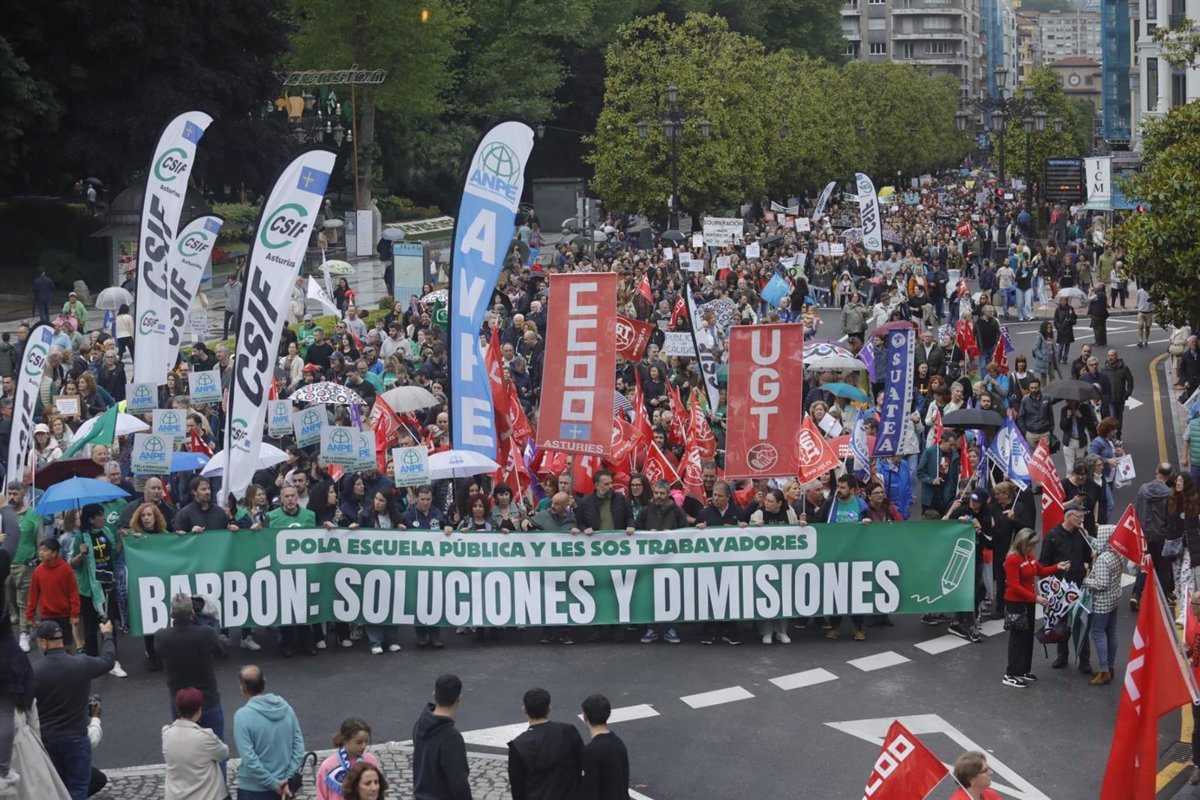
The mobilization in public education in Asturias took another step this Sunday with a «historic» demonstration in Oviedo, which filled Uría Street with teachers and citizens who, accompanied by the union representatives of CCOO, UGT, Csif, ANPE, and Suatea, demanded «serious negotiations» from the Minister of Education, Lydia Espina. In case of no progress, they have stated that they will start an indefinite strike on Monday.
The mobilization was organized after the unions abandoned the negotiation table last Friday, following a meeting with Espina, where they requested attention to their demands regarding salary equalization, attention to diversity, and reduction of bureaucracy, among other issues.
On the same day, the unions called on the education community to hold a demonstration they described as «historic». The result was a gathering of around 30,000 people, as detailed by the union representatives in Plaza de la Escandalera, where the mobilization concluded.
During the march, the President of the Teaching Staff Board, Jorge Espina, expressed his joy at the thousands of people joining «the clamor of these strike days» and anticipated that the organizations would present «a counterproposal» to be discussed at the next negotiation table with the Ministry. However, they will not make it public beforehand because they do not negotiate based on headlines like the Minister seems to do.
The General Secretary of the Teaching Union CCOO of Asturias, Borja Llorente, also spoke to the press to highlight the «great discomfort» of the teaching staff «due to the situation that the minister and the government of Asturias have brought to the educational centers with policies of cuts that were never reversed.»
Furthermore, he emphasized that, to reach an agreement, they demand «an improvement in salary for teachers, who are the lowest paid in the country despite achieving the best educational results in all of Spain.» He added, «Starting tomorrow, there will be an indefinite strike that will proceed despite the abusive minimum services imposed.»
Recall that last Friday, Espina, in a press conference, mentioned that they had proposed a series of measures to the unions totaling 14.4 million euros, including the «economic recognition of teachers with an increase in the current specific complement of 814.66 euros per year». The unions criticized this proposal as «shameful.»
A «HISTORIC» DEMONSTRATION IN EDUCATION
For the General Secretary of Education of UGT, Cristóbal Puente, the response to the demonstration call was «historic.» During the protest, he expressed his «firm will to reach an agreement,» but stressed that «all demands must receive a satisfactory response» through «a significant enough investment,» as these requests have been made for years. «There is no other solution,» he affirmed.
Puente lamented that «after an absolutely indecent proposal from Espina, she did not take advantage of the weekend to redirect the negotiations.» He explained that the Ministry of Education has summoned the unions for Monday and noted that «if the Administration wants to know the strength of the trade unions for negotiation, here it is,» referring to the multitude that joined the protest.
On his part, the Secretary of Suatea, Miguel Laria, described the demonstration as «a great vindication with a festive atmosphere,» but quickly pointed out that «the celebration does not mean that people are not clearly angry and eager to make noise, protest, and demand what we have been asking for all these days.» Along with this, he expressed hope that the minister will «present a serious offer» at the next meeting.
«We have the strength of the street, we have union unity and we also have the support of society,» declared the President of ANPE, Gumersindo Rodríguez, who recalled that the «deficit in education» has persisted for «years» and that the salaries of Asturian teachers «are lower than those of neighboring communities.» «Someone has to take negotiations seriously and transparently, without smoke screens,» he pointed out.
The President of the Education Sector of CSIF, Jorge Caro, concluded the union statements by describing the demonstration as «a resounding success» that adds to the strong support of the four previous strike days this week. «Asturian teachers have had enough,» he stated.
Regarding the continuity of the conflict, he indicated that «Monday will already be the fifth day of the indefinite strike» and that «people will not continue to endure more disrespect, offenses, or wasted time.» Finally, he expressed that they expect to be called to negotiate as soon as possible, including this Sunday.
PP, VOX, AND FORUM IN THE DEMONSTRATION FOR PUBLIC EDUCATION
Several political representatives were seen at the demonstration, including the Education spokesperson for the PP in the Junta, Gloria García, who stated she was «where she needed to be» this Sunday, «defending the quality of education and the dignity of teachers who have been trampled for years by the need to take definitive measures.»
Regarding the minister, she pointed out that, «if she was already in a weak position regarding the conflict, the disapproval of President Barbón absolutely disqualifies her from continuing in office.»
On his part, the Vox deputy in the Junta, Javier Jové, criticized Espina for «being only concerned about her ideological agenda, ‘the Asturian issues’, the language, and feminism, neglecting the demands of the teachers themselves.»
He added that «without quality teachers, there cannot be quality education» and stated that Vox supports «the call and the mobilizations» and demands «the removal of a minister who has been overwhelmed by the events.»
The General Secretary of Foro Asturias, Adrián Pumares, also participated in the event and criticized the actions of the president of the region, Adrián Barbón, considering that he intended to «confront teachers and families.» Pumares indicated that behind the protest «there are many years of neglect, lack of attention to diversity, unsustainable ratios, and lack of funding.»
He also mentioned that «there is an excess of bureaucracy in the centers and many problems that the Barbón government is incapable of addressing.»